Search topic: houseplant leaf burn
Houseplant Leaf Burn: Causes and Fixes
An English troubleshooting guide for brown, scorched-looking leaves, with ways to separate leaf burn from dryness, root stress, and placement issues.
Key Points
- What true leaf burn looks like
- How to separate burn from simple dryness
- The fastest placement corrections to try
- How to prevent repeat damage in bright rooms
Quick Answer
Leaf burn is mostly a placement problem, not a mystery disease. Once the light intensity matches the plant, the damage usually stops progressing.
Old scars will remain, but healthy new growth is the sign that your correction worked.
Table of Contents
- What true leaf burn usually looks like
- How it differs from dry tips
- Placement fixes that usually help
- How to prevent it next time
- FAQ
- Conclusion
Brown marks on leaves are easy to overgeneralize. Some are caused by sunburn, while others are really airflow stress, dryness, or old root trouble showing up at the leaf edge.
This guide helps you identify the pattern behind leaf damage so your first correction is more accurate.
What true leaf burn usually looks like
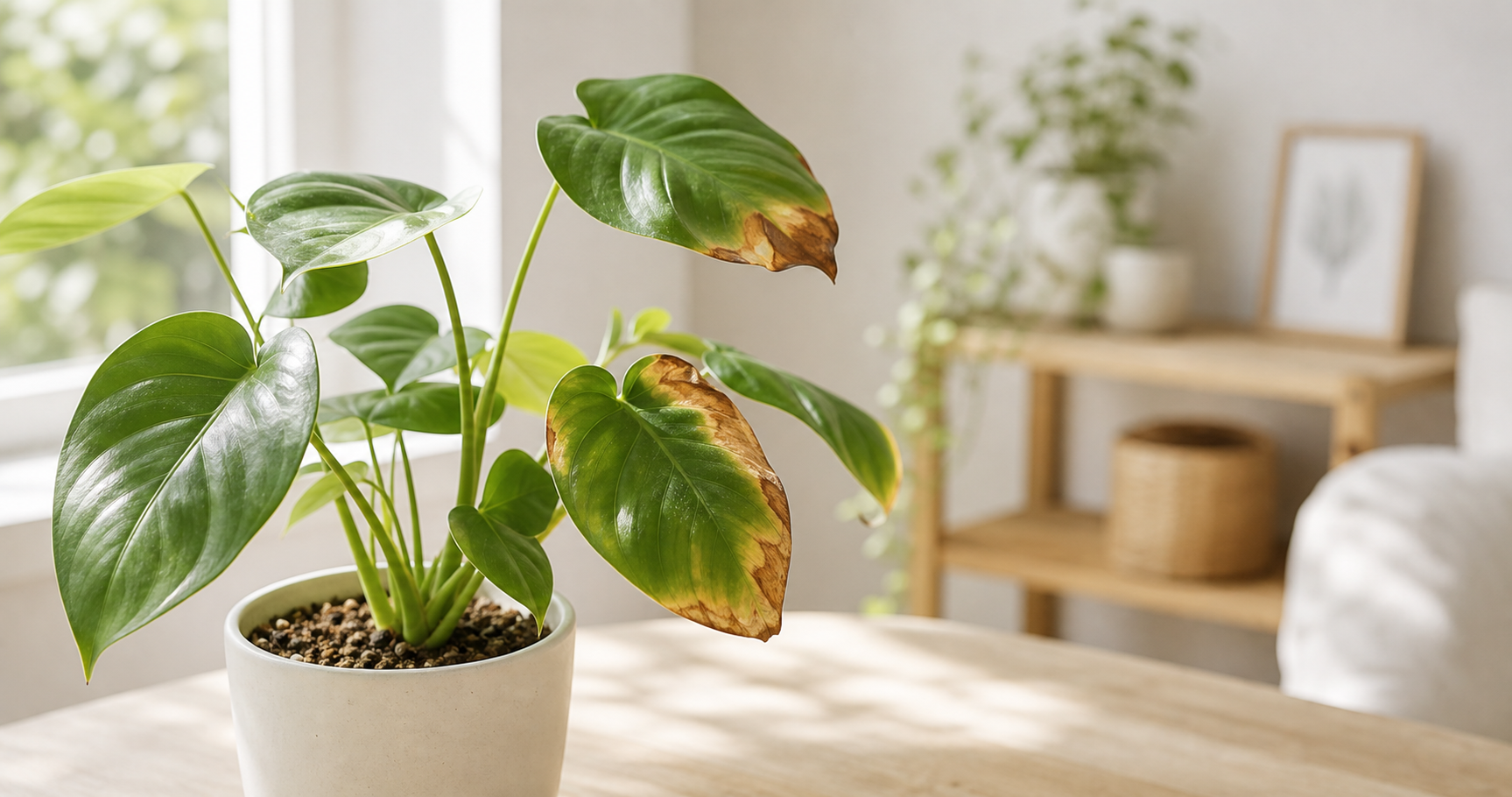
Leaf burn often appears as pale, tan, or crisp patches on the side that faces strong light. The pattern usually follows exposure rather than affecting the whole plant evenly.
Soft low-light plants and recently moved plants are especially vulnerable when they are suddenly placed in direct sun.
How it differs from dry tips
Dryness often starts at the tip or edge and may appear on many leaves at once. Burn damage tends to create harsher patches where the strongest light hits.
If the room also has strong airflow, check that factor too before assuming the sun is the only problem.
Placement fixes that usually help
Move the plant one step back from the window, use a sheer curtain, or shift it to bright indirect light. Those small changes often protect new growth without forcing the plant into deep shade.
The aim is to reduce intensity, not remove all useful light.
How to prevent it next time
When moving a plant into brighter conditions, do it gradually. Give the foliage time to adapt instead of making a dramatic all-at-once change.
Watch new leaves after the move. If they stay healthy, your new placement is usually working.
FAQ
Can burned leaves turn green again?
No. Damaged tissue usually stays damaged, but the rest of the plant can recover well once the cause is fixed.
Should I cut off every burned leaf immediately?
Only if it is badly damaged or spoiling the look. Slightly marked leaves can still support the plant.
Is brighter always better indoors?
Not always. Many indoor plants want bright indirect light rather than direct harsh sun.
Conclusion
Leaf burn is mostly a placement problem, not a mystery disease. Once the light intensity matches the plant, the damage usually stops progressing.
Old scars will remain, but healthy new growth is the sign that your correction worked.